1826 Dec 24
Major Ridge, a Cherokee chief whose wife was a Moravian, arrives to enroll his daughter Sarah (Sally) Ridge at Salem. At least 11 other Cherokee girls attend Salem before the forced removal of the Cherokee from their native lands.
1843
A measles epidemic in the spring and an influenza epidemic in the fall and winter claim the lives of three girls, one teacher (Maria Lavinia Blum), and the son of Inspector Jacobson.
1853
Rev. Francis F. Hagen, a music teacher, becomes the first male teacher at Salem Female Academy. His most famous composition is the Moravian Christmas hymn, Morning Star.
1856
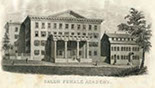
Main Hall (originally known as “the Academy building”) is completed primarily to provide more dormitory space. It is located on the site of the
Gemeinhaus, which had been given to the school in 1840, but was torn down to make room for Main Hall.
1858
Inspector Robert DeSchweinitz establishes the Lower Pleasure Grounds of which the May Dell remains.
1864
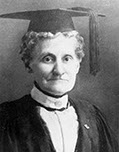
Emma A. Lehman, who was a pupil from age 13 to 16, returns to teach at Salem. Her service to the school lasts for 52 years. For most of those years, she teaches History and English Literature. Her interest in botany led to her identification of an unknown plant named Monotropsis lehmani in her honor.
1866 Feb 3
The act of incorporation of Salem Female Academy passes in the General Assembly of North Carolina, thereby separating the finances of the school from the Moravian Church. At the time, there were 300 students.
1866 Dec 11
Smallpox outbreak is reported at Salem Female Academy.
1877
The Music Department is formally established, although Salem Female Academy had previously offered extensive music instruction for decades.
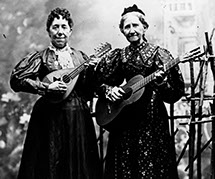
Sisters Amelia “Amy” and Louisa “Lou” Van Vleck were music teachers at Salem Academy and College. Amy taught for 50 years (1859-1909) and Lou taught for 51 years (1851-1902).
1878 June 20
Six members of the Class of 1878 are the first students of Salem Female Academy to receive diplomas for completing the “Advanced Course,” which was designed to prepare students for college entrance exams or teaching.
1886
Recognizing the fact that “many pupils will need to earn their own living, and will prefer to do it in offices rather than in the school-room,” the school begins to offer “Commercial Courses” including Book-Keeping, Commercial Arithmetic, Commercial Law, Telegraphy, Shorthand, and Type Writing.
The Alumnae Association is founded.
1888
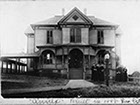
Annex Hall is built for additional dormitory space.
In 1924, it is converted to a residence for President Rondthaler and his family. Dale H. Gramley will also live there during his term as president. Today it is known as the Rondthaler Gramley House.
1890
The formation of a new department, the Industrial Department, is announced, which teaches Cooking and Dress-making.
1890 June
President Edward Rondthaler awards the first college diplomas to seven students who receive the Bachelor of Arts degree for completing “post graduate” classes. The sole degree awarded, a Bachelor of Arts, is for completing the course of study in Natural Science and Literature.